Power for Warehouses and Factories in Dubai: kW, DEWA Load and What to Ask
Industrial Insights6 min read
Ask a business owner what they need from a warehouse and they say size, location and price. Ask a factory owner and the first answer is power. A unit can be the right size and in the right place, and still be useless if it cannot run your machines. This guide explains industrial power in plain terms, and what to check before you sign.
kW, kVA and kWh: three numbers, three meanings
- kW (kilowatt) is how much power the building can supply or your equipment uses at one moment. When a listing says “450 kW”, this is the figure.
- kVA (kilovolt-ampere) is the total load the supply has to carry. It is always equal to or higher than kW.
- kWh (kilowatt-hour) is energy used over time. This is what your DEWA bill counts.
The link between kW and kVA is the power factor. Power factor is kW divided by kVA, so kW equals kVA times the power factor. A power factor of 1 means all the current does useful work. Motors, compressors and many machines draw some current that does no work, so their power factor is below 1 and the supply must be bigger than the kW figure alone suggests. Generators are usually rated in kVA for the same reason.
Utilities often charge industrial customers extra when the power factor drops too low. Capacitors fitted near motors can improve it, but they need an engineer’s design. Ask your electrical contractor whether your machines need correction, and ask the landlord whether the building already has it.
How DEWA connections and load increases work
Power in Dubai comes from the Dubai Electricity and Water Authority (DEWA). A unit has a connected load, set when the building was connected. If you need more, the load has to be increased by DEWA. You do not do this yourself. A DEWA-accredited consultant or contractor makes the application.
For smaller projects, DEWA runs a digital service called Al Namoos. According to DEWA, it covers projects up to 150 kW, takes two steps, and aims to connect within five days. Accredited consultants and contractors apply online without visiting a DEWA office.
Anything above that goes through a fuller process, and the time depends on what the network nearby can carry. Do not assume a quick upgrade. Ask DEWA’s consultant for a timeline in writing, and do not order machinery until the supply is confirmed.
What storage, light manufacturing and heavy industry need
Needs vary widely, so use these as a guide to the questions, not as figures:
- Dry storage and distribution: lighting, a few forklift chargers, loading doors, an office and air conditioning. Modest power is usually enough.
- E-commerce and sorting: conveyors, scanners, charging and more air conditioning. The need is higher, and it grows with automation.
- Light manufacturing and workshops: machines such as saws, presses, compressors and welders. Their power should be added up from the nameplates, and you should allow for several running together.
- Heavy industry: large motors, furnaces or process lines. Plan power first and choose the building second.
- Refrigeration (a passing mention): cooling plant draws far more than a dry warehouse.
To size your need, list every machine, its kW rating, and how many run at once. Add lighting and air conditioning. Then ask your electrician to confirm the total, including the starting current of big motors.
If you are setting up production, the building is also part of your licence application. Our factory licence guide covers the approvals and how to choose premises that pass them.
What the stock looks like
Power is one of the main reasons businesses look beyond the city-centre areas. In our Gulf Life Dubai Industrial Rent Report Q4 2026, the Dubai Industrial City units that state their power were mostly large units with 450-1,000 kW. In Dubai Investments Park, units that state their power range up to about 150 kW. Older units in areas such as Al Quoz often have a lower supply, so check before you plan machinery. See our guides to Dubai Industrial City and Dubai Investments Park, or the DIC and DIP listings pages.
A high-power unit costs more to rent, as the rent report notes, so do not pay for 1,000 kW if you will use 150 kW. A smaller unit is cheaper.
What to ask the landlord
- What is the connected load in kW, and is there a DEWA document or recent bill that shows it?
- Is the power single-phase or three-phase, and is the main distribution board in good condition?
- Is there a separate meter for the unit, or is power shared and sub-metered?
- Can the load be increased? Who applies, who pays, and is the landlord’s consent needed?
- Is there a transformer or substation on the plot, and who owns it?
- Is there a standby generator, and what does it cover?
- Who is responsible for the electrical installation: you, or the landlord?
Get the answers in writing and put any promised upgrade into the lease. Our step-by-step guide to renting a warehouse covers the other checks.
Budgeting for power cost
DEWA bills industrial customers by slab. Under DEWA’s industrial slab tariff (as at November 2026), the first 10,000 kWh a month cost AED 0.23 per kWh, and each kWh above that costs AED 0.38. There is also a meter service charge of AED 5, 6 or 35, depending on the meter type, and the bill adds a fuel surcharge and VAT.
| Monthly consumption | Industrial tariff (AED per kWh) |
|---|---|
| 0 – 10,000 kWh | 0.23 |
| 10,001 kWh and above | 0.38 |
As an example, a unit that uses 15,000 kWh in a month pays about AED 4,200 for the electricity itself (10,000 x 0.23 + 5,000 x 0.38), before the surcharge, the meter service charge and VAT. Machines that run all day move you into the higher slab quickly, so work out your monthly kWh from your equipment list.
Rates are reviewed from time to time, so check the current tariff on DEWA’s website or on your bill. Add the cost of any load increase and fit-out to your budget.
Looking for a high-power warehouse or factory unit in Dubai? Most of our stock never reaches the website – it moves too fast. Tell us the size, power and area you need and we will send matching units with photos and specs, usually the same day.
Frequently asked questions
What is the difference between kW and kVA?
kW is the useful power a building supplies or equipment uses. kVA is the total load the supply must carry, which is higher when the power factor is below 1. kW equals kVA multiplied by the power factor.
How do I increase the electrical load on a unit in Dubai?
A DEWA-accredited consultant or contractor applies to DEWA for you. DEWA’s Al Namoos service covers projects up to 150 kW in two digital steps, aimed at five days. Larger loads follow a fuller process, so ask for a timeline before committing.
How much power does a warehouse need?
It depends on the use. Dry storage needs modest power, while light manufacturing needs the sum of the machines running together. Add up the nameplate kW of your equipment, then confirm with an electrician.
How much does electricity cost for a warehouse or factory in Dubai?
Under DEWA’s industrial slab tariff (as at November 2026), the first 10,000 kWh a month cost AED 0.23 per kWh and each kWh above that costs AED 0.38. A meter service charge of AED 5, 6 or 35 applies by meter type, and the bill adds a fuel surcharge and VAT. Check the current tariff on DEWA’s website.
Which Gulf Life areas have high power?
Dubai Industrial City and Dubai Investments Park. In our Q4 2026 rent report, the DIC units that state their power were mostly 450-1,000 kW. Send us your kW figure and we will shortlist units that meet it.
Sources
- Wikipedia – Power factor
- UAE Media Office – DEWA Al Namoos service results (January 2024)
- DEWA – Slab tariff (current industrial tariff, fuel surcharge and VAT)
- Gulf Life Dubai Industrial Rent Report Q4 2026
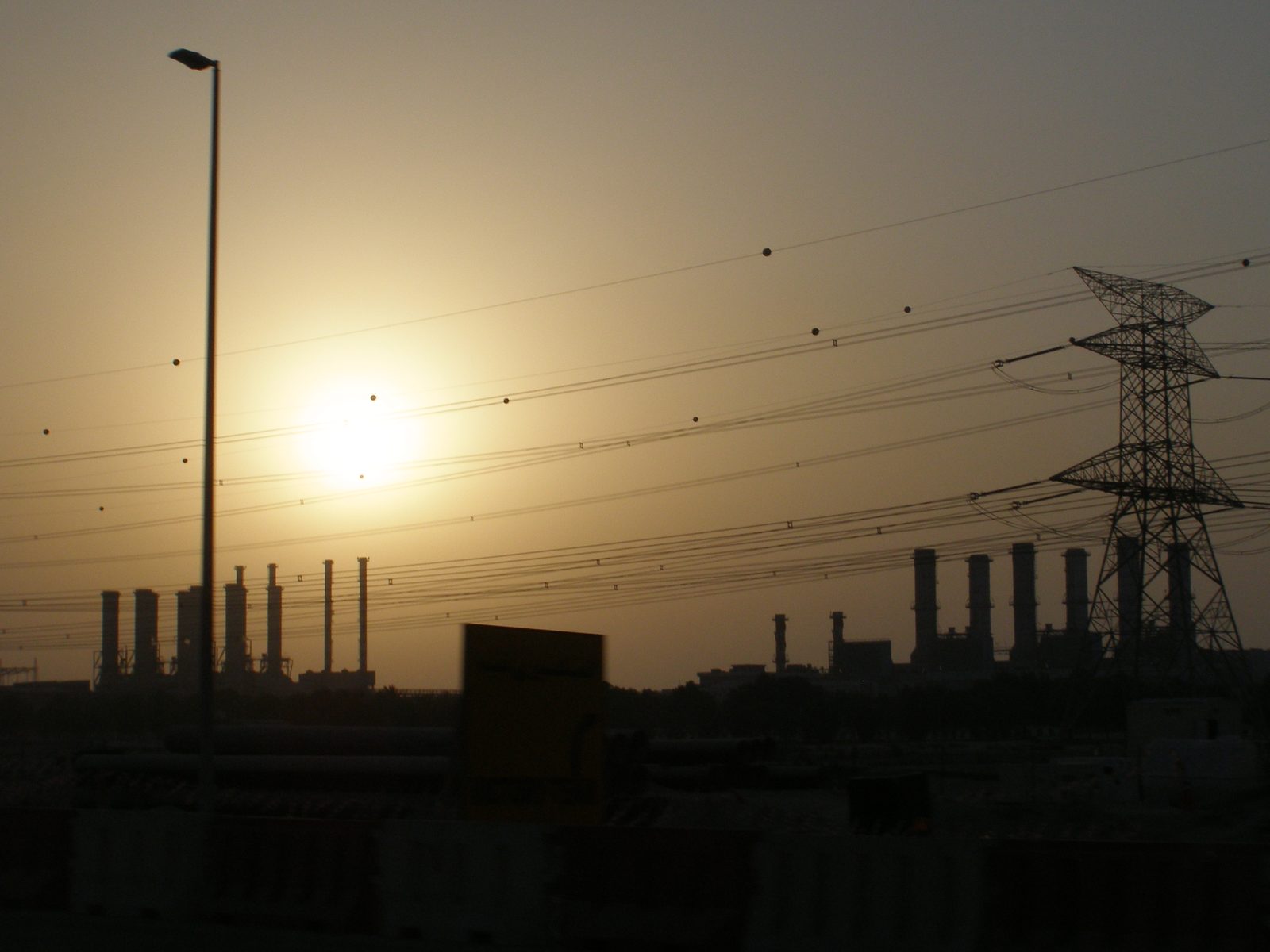
Header photo: On Rout to Abu Dhabi from Dubai by Producer, CC BY 2.5, via Wikimedia Commons.